Digibarn Collection
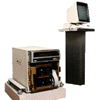
Highlights ➔ Xerox Alto II XM System Unit
Physical Object
2021.11.09.16.db
The Xerox Alto II/XM Computer
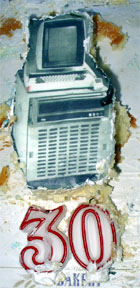
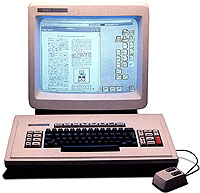
Thanks to a wonderful gift from the Mallorys the DigiBarn has a Xerox II XM and enough spare disk drives, power supplies, and other parts to get it working. We recently displayed the Alto II XM as the centerpiece of the Alto 30th Birthday Party which we held at the October 2003 Vintage Computer Festival 6.0. This page is loaded with Alto info and dont forget to also see an contribute to our guest comments on the Alto below.
Click here for more pictures and a photo montage of the arrival of the Alto.
Piecing together the Story of the Xerox Alto Computer
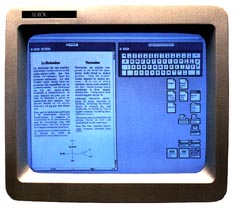
The following text was adapted from Data General's archival history pages (no longer online): The Alto came out of Xerox's original Palo Alto Research Center (PARC), known for giving its research groups substantial freedom and generous funding, and was one of the most innovative computers ever designed. Often called the first personal computer or workstation, it used bit-mapped graphics, a mouse, menus, icons and other features that would prove to be the basic technologies of today's PCs. The designers also created the Ethernet local area networking protocol to link Altos within PARC.
Unfortunately, Xerox faced competitive pressures in its mainstay copier business and decided against marketing the Alto. A commercial version, the Star 8010, was released in 1981, but was too late -- and too expensive -- to gain a commercial foothold. The Alto influenced Steve Jobs who used many of its innovations in Apple's Lisa and other machines. The Alto served as inspiration for Three Rivers' PERQ which ran the Intran publishing software that drove the Xerox 9700 high speed laser printers (also a development from PARC).
Interesting email from Chuck Thacker:
From: Chuck Thacker
To: Ed Lazowska
Subject: Re: Quick historical question
Back in the days when dinosaurs walked the earth (some of us still do) ...
- The display was 606 X 808 x 1.
- I remember being overjoyed the day (I think it was in '70) that memory dropped below a penny a bit. This opened the world in wonderful ways.
It is now at $25/8*10**6 bits, or 3*10**-6 dollars per bit.
Related DigiBarn Alto Devices Described Here
Alto and related Online and other Published Informational Resources
from Around the DigiBarn and Around the Net
Thanks to a wonderful gift from the Mallorys the DigiBarn has a Xerox II XM and enough spare disk drives, power supplies, and other parts to get it working. We recently displayed the Alto II XM as the centerpiece of the Alto 30th Birthday Party which we held at the October 2003 Vintage Computer Festival 6.0. This page is loaded with Alto info and dont forget to also see an contribute to our guest comments on the Alto below.
Click here for more pictures and a photo montage of the arrival of the Alto.
Piecing together the Story of the Xerox Alto Computer
The following text was adapted from Data General's archival history pages (no longer online): The Alto came out of Xerox's original Palo Alto Research Center (PARC), known for giving its research groups substantial freedom and generous funding, and was one of the most innovative computers ever designed. Often called the first personal computer or workstation, it used bit-mapped graphics, a mouse, menus, icons and other features that would prove to be the basic technologies of today's PCs. The designers also created the Ethernet local area networking protocol to link Altos within PARC.
Unfortunately, Xerox faced competitive pressures in its mainstay copier business and decided against marketing the Alto. A commercial version, the Star 8010, was released in 1981, but was too late -- and too expensive -- to gain a commercial foothold. The Alto influenced Steve Jobs who used many of its innovations in Apple's Lisa and other machines. The Alto served as inspiration for Three Rivers' PERQ which ran the Intran publishing software that drove the Xerox 9700 high speed laser printers (also a development from PARC).
System Specifications
Price:
Never sold but often given away. Star, a commercial derivative of Alto eventually retailed for $16,595 in 1981
Units Shipped:
2,000 inside Xerox and to universities & research centers.
Technologies:
Menu-driven, icons, mouse, high-resolution graphics on a full page monitor, 2.5 MB removable drive platters, Ethernet
Software:
Numerous applications, see the Bushy Tree diagram, Bravo WYSIWYG word processor, Smalltalk programming language and much more
Inventors:
Chuck Thacker, Butler Lampson et al
Interesting email from Chuck Thacker:
From: Chuck Thacker
To: Ed Lazowska
Subject: Re: Quick historical question
Back in the days when dinosaurs walked the earth (some of us still do) ...
- The display was 606 X 808 x 1.
- I remember being overjoyed the day (I think it was in '70) that memory dropped below a penny a bit. This opened the world in wonderful ways.
It is now at $25/8*10**6 bits, or 3*10**-6 dollars per bit.
Related DigiBarn Alto Devices Described Here
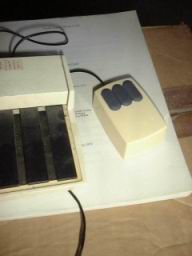 See our pages on the Alto Mouse here |
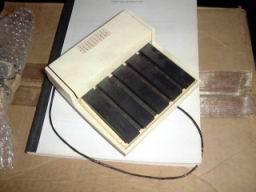 The Alto keyset is covered here |
 See a tap and transceiver from the Ethernet network that connected Altos at Xerox PARC |
Alto and related Online and other Published Informational Resources
from Around the DigiBarn and Around the Net
More DigiBarn Alto and other Xerox Resources
The Digibarn's extensive collection of Xerox computers and other artifacts
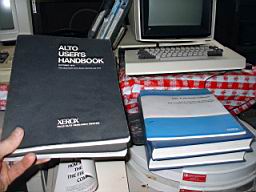
Our extensive Xerox Documentation including the Alto User's Handbook
DigiBarn Produced the Xerox Alto 30th Birthday Celebration & D* Machines Extravaganza at the Vintage Computer Festival, October 11-12th, 2003. Hear the audio and see the video of the panel by John Ellenby, Charles Simonyi, L Peter Deutsch and Dave Robson.
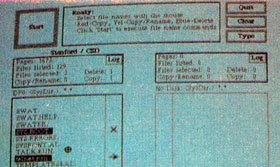
Our pages of old screen shots of the Alto OS and applications in action as exercpted from The Xerox Alto computer by Thomas A Wadlow, from Byte 9/1981. (thanks Marcin Wichary).
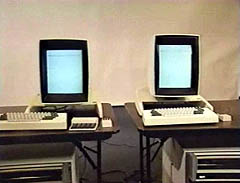
See the Alto in Action, running Maze War (13MB Quicktime movie)
DigiBarn's reproduction of Butler Lampson's famous 1972 memo "Why Alto"? and a related quotation from a lecture referencing the Alto by Butler Lampson at the CS department at the University of Washington.
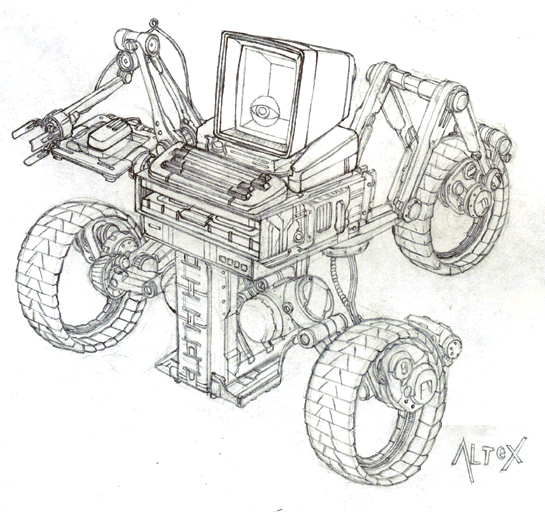
Altex Kiel Bryant Hosier's whimsical treatment of the Alto and other Compubots
See the DigiBarn Museum's pages on the Xerox Star 8010 (Dandelion) and Xerox 6085/Viewpoint
See Alan Freier's DigiBarn pages on the history of the Xerox D* Machines, Mesa PrincOps and Wildflower
See also: the DigiBarn Computer Museum Links Regarding the Birth of the Graphical User Interface
Dave Curbow's extensive Xerox Star, Alto and other Historical Xerox Documents hosted at the DigiBarn.
See our pages on the Three Rivers PERQ, a direct commecial copy of the Alto
Other Alto and Resources from around the Web
See Alan Kay's article on the Alto (included in A Decade of Research, Xerox PARC 1970-1980, reprinted from Scientific American, 1977)
Comments by Digibarn Virtual Visitors
From Chuck Baker (April 11, 2007):I enjoyed your info on the Xerox Alto. As a Xerox service rep, since 1979, I have seen and chuckled at the arguements and suits involving the source of the GUI, mouse, and ethernet.Reply from curator Bruce Damer:
Back in the day, Xerox sent all of us service reps. to it's training center in Leesburg,VA for each model copier that we were to repair. In 1980, I was sent there to train on what was already an obsolete copier (the 2400/7000 family) with a curved glass and a mirror that tilted back and forth to enable higher speed copying. In that class with me was a technician from PARC that was training on this copier because he was to repair the prototype laser-printers being developed there and some of them used this frame due to its huge size. Along with him, he brought one of those disk platters and invited a few of us down to a room at the center that had a bunch of these Altos in it networked together. He loaded a game based upon Star Trek. It was fully graphical and networked!! We each sat at our own Alto and used a mouse to shoot at the enemies (other classmates sitting at THEIR Alto) that appeared on our screen and control our shields, phasers, photon torpedos, in real time!! It sure was a long way from the paper eating, TTY terminal interfaced, version I had played at Clarkson College, a few years earlier.
This was the first time I had ever seen a networked game. Do you have it? Was it the first? It was years before anything like that made it to the consumer market. BTW, do you have only one, or several of these networked? Just curious ;P
Great stuff Chuck! You are in luck, you can see a screen shot (probably from a polaroid photo) of the Alto Star Trek game here on our site! As to your networking question, we only have one Alto and sadly it is not quite booting up. We are lacking one board and a bootable Alto executive disk. You can see two networked Altos in action playing Maze War here though. Enjoy!