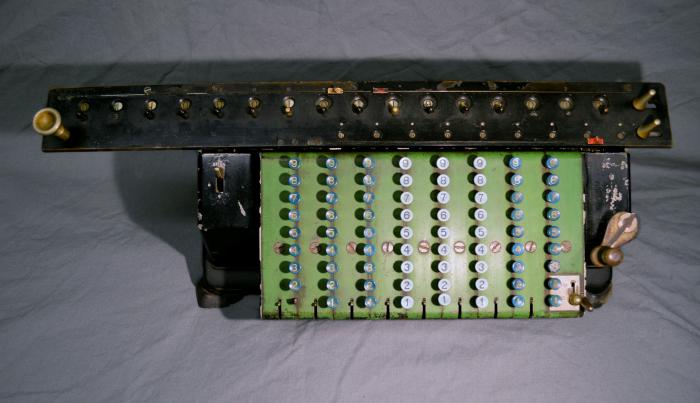
Top view of Unitas TIM
Unitas T.I.M. Calculator Machine
Physical Object
2019.07.02.05
By the early 20th century, Germans who had gained experience in the calculating machine industry were opening new companies of their own. In 1907 Ludwig Spitz, an attorney who had represented German calculating machine firms, founded Ludwig Spitz & Co. in Berlin. The company sold improved forms of the arithmometer, particularly using designs of the engineer Robert Rein. These machine sold as the “T.I.M.,” which the company said stood for “Time is Money.” A German firm's choice of an English motto associated with Benjamin Franklin is noteworthy. Spitz was particularly proud of the “Unitas” machine, which united two carriages in one, making it possible to compute both subtotals and grand totals. This relatively early example of the Unitas, made of brass. It has 10 levers for setting numbers, with windows behind the levers to show the number set up. Below these are the stepped drums. Behind these is a carriage with a seven-digit revolution counting register and a 12-digit result register. Behind this is a second carriage with a second result register. Metal grooves carry sliding decimal markers for each register. Right of the digit levers is a lever for setting the machine to addition/multiplication or subtraction/division. When the lever is in the add position, both carriages show results of addition. A crank for operating machine is at the right front. From 1909 the Unitas was produced with a metal stand rather than the wooden case.